BOOK REVIEW: The Mystery Of Blue
Author: utbt5 Jul 2011
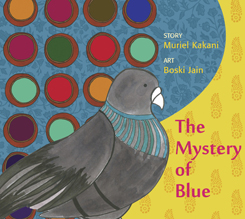
The Mystery Of Blue, By Muriel Kakani, Art By Boski Jain, Publishers: Tulika Books, Ages: 6 – 9, Picture courtesy: tulikabooks.com. Review written for Saffron Tree.
Have you read Sivakamiyin Sabatham by Kalki? If not and if you can read Tamil, you can read the whole novel here. Sivakamiyin Sabatham is a historical fiction by Kalki, written in 1944, for over a period of 12 years, in four parts and 209 chapters. It truly is a master piece and one of the main reasons I want my kids to learn how to read Tamil, is for them to read Kalki’s work in its original form. No, this is not a review of Sivakamiyin Sabatham. But there is a point behind this digression.
The one line story is, ‘The Pallava prince avenges the Chalukya king who kidnapped his love, the dancer Sivakami.’ How did the Chalukya king manage to kidnap Sivakami, the Pallava prince’s lover, in the middle of a siege with the whole Pallava army watching? The answer to this is, Sivakami’s father – a gifted sculptor sneaks out of the Kanchi fort, with his daughter and willingly takes refuge with the Chalukya king because he is tricked in to believing that the Chalukya kings knows the secret of the permanent natural dyes used to create the Ajantha paintings! So great is the imaginary character’s desire to find out how the natural dyes were created in the 2nd century BC, that he walked out on his benefactor, in to enemy camp and thus offsetting a series of events in Kalki’s imagination!
The novel leaves the reader wondering, how did so many colors exist in India? How were they created? How were the primary colors extracted? Were the vegetable dyes treated specially for them to last through the centuries? If the dye pigments were extracted from the flora unique to a specific region, how were the same primary colors extracted through out the country? Was the knowledge about the dyes and the extraction process freely shared or was it kept under lock and key?
These are the questions explored in Muriel Kakani’s, The Mystery Of Blue. The story is narrated by little Kunku from the village of Ilkal. Kunku’s father and mother are dyers and weavers like the thousand other people in their village. As Kunku describes how her mother makes different colors from one pigment, one cannot help but wonder the scientific process behind dye making! Also one is filled with awe how the people in old times lived with a deep understanding of nature and the numerous experiments they had to go through to isolate the pigments. Kunku’s world is filled with orange, red, maroon, purple and pink. One day, Kunku, inspired by the blue shade on her pet pigeon Chandrakali’s neck embarks on the journey of making blue. See how nicely the author touches on the possibility that the artisans were influenced by the colors they see in nature?! How Kunku and Chandrakali manage to make blue is the rest of the story.
The illustrations are rich and captures the essence of the story. As the story proceeds the warm earthen tones give way to the cool blue, stately indigo, royal purple and soothes the eye. The block print patterns are gorgeous.
We have owned this book for two weeks, but I have read it as a bed time story many many times. The children are enjoying the beautiful illustrations and are learning how the ancient Indians worked scientifically and in unison with nature. I am not complaining.
Before I Forget…
Author: utbt28 Jun 2011
Sunday afternoon.
The children are playing in their room and I am watching them play.
They are pretending that they are selling mangoes:
Mieja: Amma, would you like to buy some magical mangoes from me?
Me: Ummm… that depends on the price. How much does your mangoes cost?
Mieja: Oh, don’t worry about that amma, the mangoes are free. Would you like some?
Namma than free-a koduthal phenoyl kooda kudipome (We belong to respectable family that will drink even phenol, a cleaning liquid, if it is free), so my eyes light up!
Me: Free? Sure, I will have 2 kgs.
Meija: Here amma.
She hands over the mangoes and says,
Mieja: Amma, but these are just the mangoes. The magic is separate. You have to pay me to sprinkle the magic on the mangoes. That is not free.
I am stumped! I am upset that I signed up for this deal without reading the fine print.
Me: You never told me this! I thought that I was buying magical mangoes. I don’t want your magic. I will just make do with my free mangoes.
Chula, neatly cuts in,
Chula: Amma, I understand why you are upset. But the magic makes sure that you don’t have to keep buying more and more mangoes. Once you eat a mango, another one will appear magically. Don’t you think it is worth it? Isn’t is a great deal?
And I did buy the magic, with many possible career choice for the girls running through my mind, with a sheepish expression, with my pretend money.
T Is For Transition IV
Author: utbt24 Jun 2011
The thing about settling down to a life in India is that, no matter how much one is prepared, there is always a hidden factor that throws your loop out of sync. For example, the community we live in, is well serviced and plumbers come to your door step in minutes etc. But that does not mean that your bathroom leak will be fixed ASAP. (Read in IF YOU GIVE A MOUSE A COOKIE style)
If your bathroom has a leak,
The plumber will most probably say that it is because of the water heater.
If you call the water heater repair technician,
He will respond in about 24 hours.
If the water heater technician inspects the unit,
He would most probably be the person who changes ONLY the coils and points you to another person.
If after 10 phone calls you get the other person,
He would say that he cannot do anything till he speaks to the first technician who came ti inspect the unit.
If you make a date for the two,
The both will agree that a replacement unit needs to be ordered.
If you ask them to do it,
They will do it and say that the response time is 7 – 10 business days.
If you try calling them in between to find out the status,
They will not pick up the phone.
Mean while water is turned off in your bathrooms. Currently we have one bathroom in which the only the toilet works, one bathroom in which only the sink works and one bathroom in which only shower/heater works. All this gets to you at certain point of time and you go immerse yourself in Bikanervala chaat.
Three words – Bikanervala – chaat – yuuuuuum. Thanks A-kay for mentioning it. We were en-route to QMart @ Banjara Hills and I saw Bikanervala, decided to scratch Qmart and indulge our palate. Of course the fact that we were completely lost and were rather hopeless about finding QMart was a big factor in the sudden change of plans. The ground floor is fast food style. You order, pay, self serve. Seating management is streamlined by staff. Some one takes your name and then calls you in about 15 or so minutes, this on a sunday night, peak crowd. If you don’t want to wait, they also have a sit down restaurant upstairs. Of course pricing is up-marked. I did my hallmark test – Bhelpoori, pani poori and ragada, order and assess. The result was out in flying colors. The kids enjoyed the bhelpoori and there wasn’t much left for me. Mieja approved the kesar pista kulfi. The rad thing we did is to give the kids filtered water from the restaurant instead of ordering bottled water. I mentioned to R in passing that the next thing for me to do is to order bhelpoori from street vendor. He thinks it is a joke.
Right next door to Bikanervala is Karachi Bakery. Chula(yeah, she is such a sport*) and I dived in to the traffic at Road#1, jumped over the divider to go to Karachi biscuits. I think that says it all 🙂
But for the Rs.25 entrance fee and Rs.20 parking fee, I can totally see myself living in Shilparambam. I have my eye on some of the craft classes they offer. I did mention to R that I am going to take a block printing class and make curtains for the house, the way I want it. Again, he thinks it is a joke. I found some awesome Pathachitra artists, Madhubani artist, Kondapalli dolls and Channapatna toys. The Madhubani artist was super thrilled that I knew the name of the art form and offered me a seat to sit and watch him do the work. He forbid me from taking video/pictures though. I was doing a mini interview of sorts with him. Also found in Shilparambam this cool easy chair at a wood working shop. And some clay pots. And some trinkets. And kurtis. And shawls. And bags. And….
One thing I was sure I would miss from US is Amazon. Apparently not. I am now in Flipkart heaven. Excellent customer service, hassle free ordering and good prices. They have something called cash on delivery(COD) and I am taking full advantage of it. I have already exhausted my self imposed cash limit for book ordering for this month and waiting for July to use up my next month’s quota.
The only good thing that can come out of the situation where your child comes home with a palm sized and growing, red, hard, painful, itchy swelling on her hip is that you get to experience first hand the working styles of pediatricians. We went to couple and liked the later. So that has been sorted out. Phew!
*On the subject of crossing roads, while visiting clinics, we had to cross a busy intersection. Mieja was very scared and after the experience she told me, ‘Amma, if an auto hits me, I could die. Did you even think about that?’. See why I called Chula a sport?!
D Is For Driving In India
Author: utbt21 Jun 2011
After telling the whole world that I want to take a break from driving and how I want to be driven around for at least two months, here I am, driving. (Oh, which implies that we bought a car, a subcompact automatic. )In a way this is okay because if I had stayed away from the wheel longer, the road fear would have gotten to me.
Driving in India is a two people job. One person to drive and one person to honk. The hands at ‘ten-and-two’ position has been rapidly altered to ‘hands-at-center-of-the-circle-and-two’.
Remember the saying ‘innocent until proven guilty’? Along those lines, people who drive in India believe that they have the ‘right of way until some one else honks and reprimands them’.
The honking can mean multiple things depending on the driver’s mood and the size of the vehicle the person drives. Some of my interpretations are – Excuse me; Move it and move it now; FYI:I am right behind you; What the hell are you doing?; I am privileged and deserve royal treatment; I am huge and need more clearance; I am young and reckless; #$$%^%$#
People are extremely optimistic and they are not quitters. Just because I think my subcompact car will not have enough clearance to go in a two feet space between two pillars does not stop a Innova driver or a lorry/bus driver from trying.
People believe in progressive crossing. The four way intersection and how people navigate this intersection is nothing short of a miracle.
The job of traffic police who works busy intersection is same as the job of a preschool teacher left alone to handle way more kids than she can handle AND she does not speak the same language as the kids AND all her kids are having a bad day. Poor guy.
One can’t even begin to imagine how many heart attacks a left-right challenged person like me gets. As is I have to think twice before I figure out left from right. Then I have to consciously curb my instinct to go right and keep left. Then I find all these people driving on the opposite side of the road. Tsk. Tsk. Tsk.
O Is For Oxymorons In Parenting
Author: utbt18 Jun 2011
When my child is eating, all by herself, without any fuss what so ever is the time I feel like putting her on my lap and feeding her.
For all the talk about how I want them to be independent, I equally agonize that they have to go and come back by school bus. And if I am late by even a minute to pick them up when they are dropped off from the school bus I imagine that they are lonely and vulnerable and get stressed.
For all the encouragement I give Chula about reading and take pride in the fact that she reads with passion, I also tell her that she need not read every single print she sets her eyes on, especially my emails and blog posts!
After agonizing over the bed time, battling them and after putting in so much effort in making the children sleep, I feel the most love for them when they are finally asleep and can’t wait for them to get up.
When they need me most to engage them is the time I am hard pressed to finish something and expect them to play by themselves.
Ideally I want the children to dream, dream big, imagine and fantasize. But when Chula is elbow deep in her dream, completely lost in a world of her own, which unfortunately coincides with strict time lines like school bus leaving in another five minutes is when I have to shake her out of her dream and point out the usefulness of being practical.
After harping a lot about being kind and every one doing their bit to help other people, one is forced to give their children a big lecture about how giving money to every single person begging on the road is not possible, does not help them, does not eradicate poverty.
I made a resolution to not stress on the birth order, mainly because the older one is only 18 months older. But am now forced to tell the younger one not to compare herself with her sister and agonize over the things she cannot do as well as her sister because….well her sister is 18 months older than her.
I am forced to tell Chula that she does not have to sign a bond of friendship in blood with every child she ever sets her eyes on and expect the same level of commitment from the other child. Right after this I have to tell Meija that she needs to be more open, let people close to her otherwise she cannot make friends.
I have to stress time and again that they have to give their 100% in every single thing they do, that is all that matters and be in the position to eat my words and tell them to finish certain things ASAP as it is not worth this much of their time, patience and energy.
I have told them to be wary of strangers and also be courteous to strangers, sometimes these sentences are back to back.
I tell them that they can help me in household work and when I find that at times I have to help them to help me, I take it back.
G Is For Gold(And Silver)
Author: utbt16 Jun 2011
Again it was R who said, ‘Well…Meija is leaving school too. She needs to be recognized and it needs to be a separate ceremony. This child cannot be in her sister’s shadow all the time.’ We were never expecting this and were super thrilled, most of all Mieja was very excited. She chirped to all who cared to listen that she was going to have a circle goodbye ceremony. We decided on a small ceremony in circle where the children sang a small song, the teachers talked about the significance of the song and the children shared their views on friendship.
Getting to say proper goodbye, however painful it is, is an absolute necessity, especially for children. They learn that their old friends did not just vanish, but are still there and it gives them the confidence to make new friends in the new environment.
Here is to the (g)old and new.
G Is For Graduation
Author: utbt9 Jun 2011
When we first told Chula’s class teacher(also the school founder) that we are planning to move to India, R’s first question was, ‘Of course only after she finishes her graduation ceremony with us right? Because you know how much she is looking forward to graduating’. When R found out that it was not the case, she was more upset than us. She said, ‘Its only a month, so leave her with me, she can graduate and then join you guys in India’, we both laughed it off and pretended that it was not a serious offer. Two days later she asked me again if we are serious about moving before the graduation. We were, with school starting in India on June 13th, I wanted a month in between to settle down. ‘Well, in that case’ said R, ‘Chula will have a graduation. A special one, a proper one, with all bells and whistles. Even if she is the only child who is graduating in this ceremony, we will not cut any corners. The child deserves it.’
So the school sent a letter to all parents that Chula will have a special graduation. From time to time they discussed in circle time about what would be a fitting farewell for Chula and Mieja. Ideas were pooled, teachers made a special graduation hat and the children practiced their songs. Chula wore the school’s traditional graduation attire, sang songs, recited a poem, did a special Indian folk dance and made a ‘WHO AM I?’ poster. It was a touching ceremony. Almost all the adults present cried. Who wouldn’t when you hear a bunch of children singing this?
PS1: This is 1/5 songs the children sang.
PS2: Mieja wasn’t left out. G Is For Gold(And Silver) follows soon.
T is For Transition-III
Author: utbt5 Jun 2011
We got water.
We have been relying very much on Team-BHP for car reviews, comparisons and such. But if you want to post a query, then plan ahead. These guys are serious about the content that goes on their website. They take a week to approve your registration.
We came across an organic exhibition collaborated by Deccan Development Society, Sahaja Aharam and Chetna Organics. Apparently every Wednesday they bring their vegetable truck to our apartment. Also there are options to order small/large vegetable basket. Their price chart seems nominal. I compared their prices for rice, jaggery, pulses and flour with Hypercity prices and the difference was less than Rs10/item. Also found 24Letter Mantra on web through MetroMela reviews. Will try out all the three places and update.
Search is on for organic milk, but I am not hopeful. The habit of getting a gallon of milk and having it at my disposal in the fridge for a week is very much second nature to me. So this half liter milk packet business is going to take a while for me to get used to. Since Mieja is still not over her lactose intolerance thing, I am buying soy milk cartons and masala buttermilk cartons for the children. At least two members out of the variable for now.
The amount of added sugar in the flavored milk, soy milk and butter milk is appalling. I find myself reading the nutrition content over and over again.
Have you read the Roscoe Riley series? The titles go ‘Never glue your friends to chairs’, ‘Never trade your sweater for a dog’ and so on. Hilarious books, much enjoyed by Chula. Along those lines, if I were to write a book and want the title to say it all, it would be, ‘NEVER TAKE YOUR CHILDREN WHEN YOU BUY UNDERWEAR FOR YOURSELF’.
T is For Transition-II
Author: utbt2 Jun 2011
We have moved in to the apartment. There is no water in the kitchen. The story goes like this. The rubber pipes connecting the faucet to the water pipes are small->They leak->Solution change pipes. New problem->the granite hole is not big enough to fit big rubber pipes->Solution: drill a bigger hole. New problem: Special granite guy has to be procured and no one wants to come all the way for such a small job. Cribbed to the landlord enough and he has arranged for some one to come, with a full day pay(for a 30 min work) and transportation to come and drill. Today is the promised day and hopefully there are no new problems. Till this gets resolved I have to walk for 10 minutes, in the glorious Sun, with two children in tow, to the supermarket in the apartment complex and get a crate of Aquafina, carry it back to the apartment and cook. Though it took me three hours, made paruppu rasam, beans curry and stuffed kathirikkai poriyal yesterday. Chula hugged me and said that I am the best cook in the whole world. Washing dishes is a biiiiig story, MGM has reserved rights and I cannot share it here.
Because of all the activity, all my attempts to kick start activity, we have taken to eating lunch at 3.00PM and skip dinner. Having a child who does not believe in food and one who can live on white rice has its advatages I am finding out!
The language barrier is a H.U.G.E barrier for now. I am bad in languages to start with, some people just don’t have the ear for it. So learning a new language at this ripe age, even though I am trying hard, is not going well. I know a few nouns and few verbs in Hindi and try to make a sentence with lots of actions. For the most part people understand, or at least have an idea of what I am trying to say. The other day, I introduced R to my helper as, “Yeh, mera pathni hai.” She laughed non stop for almost six minutes, clutching her stomach, with tears in her eyes and all that, but she understood. Same way, I told the washing machine guy, “I(pointing to me) live hotel(making inverted V shape with hands). OK. Apartment empty. OK. No saman(shaking my head). No people(head shake again). Bada(making a random shape with hands) lock outside. OK. So dho(two fingers) gante-ki(showing wrist cos thats where a bloody watch goes) bath(throwing hands behind my shoulder), you call(telephone action) mobile-se. You come, then I come. OK????” I think, if I make enough hand movements and add se-ki-hai every now and then, I am speaking Hindi. I will not even go in to my conversation to supermarket guys asking for electric toothbrush. From far away, people thought I was displaying some kind of primal territorial dance. All the above I put down under effective communication. The difficult part is when I have to talk to some one on the phone. Oh god, just kill me.
Speaking of electric tooth brushes it is like finding Waldo, it is somewhere, but haven’t found one yet.
48 hrs after landing, I took my iPhone to a place to get it unlocked. I was worried about data loss and other general screwups, it being an iPhone and all. So the guy gave me a sarcastic smile and said that the unlocking part will be the easy part. I understood the full meaning of his statement when we were waiting for Airtel gods to grace us. Multiple trips, document copies and 10 days later, we finally got a SIM card. That too only after R completely lost it when the guy said, after we made multiple trips, gave all document copies, that R’s driving license(that is valid till end of July 2011) is valid only for two months and asked us to come after two months with a renewed license.
Gas connection is said to happen six months from now. We are not a bit hopeful. Solar stove in the balcony seems like a more viable option at this point of time.
Current neighbor report – many really nice, one acted as if I tried to snatch her husband when I asked about finding house help, one nosy. R is telling me that not every question needs to be answered. If I cannot give a suitable reply, I have to smile and switch conversation.
Getting landline and broadband can be checked off our list. Though it took a week, by far BSNL was the easiest thing. Managed to find a bank close by and opened an account. Now we have two documents as address proofs. Yay!
Hyderabad is a foodie heaven. Here are two more of my finds. Prego Italian restaurant in Westin serves the most awesome ravioli. Fluffy little pillows made with lots of spinach, very little ricotta cheese. The tomato-basil sauce on the pasta just blew me away. After I finished eating, Chula commented, very innocently that my plate need not be washed! The great kabob factory – have heard many good things about this place, finally tried it couple of days back. Hmmmmmm!!! Their rajma patty is so moist and mouth watering. Adding vellari vidhai to the sweet sauce is genius. Liked, no make it loved, everything they served us. Very friendly host.
Last week went to the Chilkur Balaji Temple. Its a 17th century temple, very unassuming and is 40 minutes from Hi-Tech city. I was very impressed by the fact that the temple does not accept any donations. It is a no-Hundi temple! The head priest speaks at least a hundred languages, may be even klingon, told me in tamil that the only thing a devotee needs to give god is his heart and not money. We were told that people usually make 11 pradakshinams in their first visit and make 108 when their prayer is answered. The temple closes at 8.00PM sharp. If you land there at 7.45PM, you will be sucked in to the whirlwind of people trying to finish their 108 pradhakshinams and you will be carried around the temple with no effort on your part 🙂
The girls have taken to the Puri Jagannath temple in Banjara Hills, because they have picture stories on the walls. Krishna is not in the Dasavatharam picture, I wonder why.
Visited the Golconda Fort last Sunday. Picked up a tour book for Rs.20, bad editing, but kind of gave us an idea of what we were seeing. Be it Machu Picchu or Golconda, it is not the fortress itself that is impressive. It is the design, the acoustics, the aqua ducts, the engineering behind it is what is amazing! BTW, Golconda dates with the Machu Picchu 🙂 Walked up most of the 380 steps, shocked that they were cooking biriyani inside the fort and saw the light show. We carried water and mosquito repellant. The light show starts sometime around 7.00PM and is a compilation of many historical facts about the fort. It is good, but there is room for improvement. I was expecting visuals, different color lights on many different spots can hold ones attention only for so long. Even Chula said after the show, ‘Amma, I was almost expecting fire works at some point amma.’
T Is For Transition
Author: utbt30 May 2011
Its been two weeks, since we landed in India. Has the transition started? Yes and no. No because, we are still put up in a hotel, so we are still in a bubble. Yes because, we are getting the flavor of the city.
Let us start with the food. If you like your jilebis warm+crisp+fresh+just a hint of lime juice without the scary red color, go to Ohri’s @ Banjara Hills. The jilebis hit all the right notes. The kids being used to grocery store jilebis, declared that the Ohri’s jilebis are ‘odd’. I said, ‘fine’, packed the rest and devoured them at 2.00AM, when jetlag wouldn’t let me sleep any more. I also tried their Dhai battata poori, very forgettable.
After eating americanized Indian food in the hotel we are staying and eating indianized American food in food courts, I was thrilled to be at Bhimas Chithram restaurant @ Jubliee Hills. Their chutneys are to die for. I ordered a spicy masala dosa and as I ate it, I cried, drank tanks of water, profusely perspired and thoroughly enjoyed it. If you are planning on ordering the Bhimas spicy dosa, it is a ‘complete’ cleansing experience, so plan accordingly.
Little Italy in Film Nagar, Jubliee Hills serves my kind of Pizza – vegetarian, thin crust, low on grease, with little cheese, some spice and a touch of paneer. They have a very interesting mocktail list also. I tried something with green grapes, mint and lime – tasty and refreshing.
Also tried the famous Paradise restaurant at Hi-Tec city and 36Chattees. Guess a carnivore would love it, but as a vegetarian, I nibbled on the vegetarian options and made sure that meat did not touch my vegetarian food.
Hyderabad boasts that it has the biggest mall in South India and Inorbit in Hi-Tec city is HUGE indeed. Sprawled over 5 floors and a massive Walmart Super Store like grocery store(Hypercity) I run to it for my every need. But I swear on all things good in my life that I will never set foot in Inorbit on a weekend evening, not if I can help it, so help me god.
Read about DIALOGUE IN THE DARK restaurant and badly want to try it out. R is the kind who wants his food to have name, so that he can form his biases even before tasting it. Needless to say he is not that keen about DITD. If I am in San Jose right now, I would have left the children with the husband and would have gone with YaadaYaada. Sigh.
(For more details regarding the dialogue in the dark concept read this.)
Hunted down a juice shop where they sell sugarcane juice. Unfortunately they do not crush ginger and lime with the sugar cane. They add ginger juice and lime juice to the sugar cane juice. The taste is not the same. Planning on asking them to improvise the next time.
I find myself repeating to every driver, attendant, store keeper, sales person, waiter ‘DON’T TOUCH MY CHILD’. Might be a simple display of affection on their part, but I find it very disconcerting.
The potty process has taken a major set back. At last when I thought that my assistance is no longer needed in their daily ablutions, the water element intervened. ‘Amma, why do India people like to spray their butt?’ is the top why question of the week. I gave up and picked up a bundle of toilet paper from the supermarket.
Car hunting is going on in full swing. All my dreams of driving a hybrid automatic Prius has been crushed by the fact that Toyota Prius is being taxed at nearly 125% of its original price. So I researched Carwale and Cardekho and the only hits I got for key words ‘hybrid automatic transmission’ was the Mahindra Scorpio. There I was dreaming that I will be driving an eco friendly, non-polluting vehicle and will go around the city like ‘Sorna akka’ and again the dream was crushed by the Mahindra’s hybrid farce. Whoever in the world put Mahindra Scorpio and hybrid together, needs a serious hybrid101 lesson, even if the person defends themselves that it is a micro-hybrid technology….my @$$ is my response to them. But I am not budging from the automatic transmission. Currently after reading this, I am convincing the husband that we must buy an used automatic car and fit it with a made to order hybrid engine. Here I am trying to save the world and what does the husband do? He takes a dig at my (non)Hindi speaking skills. Life can be difficult when one is surrounded by dream crushers.
More transition notes to come.


Recent Comments